
More...
Miscellaneous
Owner: Todd Lumiere
Showing all 3 items.
Find
April 22, 2022
This is a peeve of mine, and perhaps it's only me; if so, I apologize.
When writing code, I constantly browse the web, for a wide variety of reason, including getting answers to very specific questions. (I assume all programmers do this, despite the common belief that we should all be able to do it all from memory.) The thing that drives me crazy is when I find an answer (like to the question: how do I get asp.net to allow either cookie or jwt authorization), and the answer includes how to create a project. Or how to install Visual Studio. Or this history of programming. I don't want to create a project, I want to get my existing project to work in a new way. Would I really ask a (somewhat) arcane question if I'd never used Visual Studio before? or programmed in C#? or created a project? or understood a little about web programming? I totally understand that sometimes someone might come along looking for a very specific answer with absolutely no background experience, but just give them a link to another page, or tell them to look it up. I also acknowledge it's not a huge burden to scroll down several screens and then pick up the thread of their (often excellent) explanation to find my answer. But really, answers to questions should be answers to questions not beginner tutorials. All that said, I enormously appreciate the vast quantity of work people put in and their generosity in sharing it.
* * *
March 14, 2020
Experimenting. I'm pretty sure my popcorn won't pop because it got too dry. But I'm mystified because I opened a second bag, and it didn't pop either. I've found here and here info about people adding moisture to their popcorn. I tried, but it still didn't work (which is when I opened the second bag). Maybe there's still not enough water? Maybe too much now? I'm going to do this the right way.
Take 20g of your "pop" corn. Grind it up and heat it up. Weigh it again. Whatever weight is gone was water. Wight Lost / Original Weigh is the percentage that was water. Or Remaining Weight / Original Weight is the percent that was corn.
You want .135 of the final weight to be water. Total New Weight = Weight of Water + Weight of Corn = .135 Total New Weight + Weight of Corn, or Total New Weight = Weight of Corn / .865. Weight of Corn as above is (1 - Remaining Weight / Original Weight / New Weight so:
Added Water = Total New Weight - Total Old Weight = Weight of Corn / .865 - Total Old Weight = Percent Corn * Weight / .865 - Weight.
So if we grind and dry 20g of corn, and it weight 19g, it's .95 corn; then we have 100g corn, we want to add water:
Water Added = .95 * 100 / .865 - 100 = 9.8g
To test, 5 grams water already in there, 9.8g added, total weight is now 109.8g; (9.8+5)/109.8 = .135 bingo.
* * *
January 26, 2019
My basement was flooding. Water covered the floor in the area where the water main had backed up in the past. I called the plumber for my periodic rooting, and vacuumed up as much water as I could, sorting the detritus into dry and diry piles. I stopped using all water in the house so no more would back up into the basement. But water kept seeping in. By my third trip to the basement to check and vacuum (all homeowners need a shop-vac that can vacuum water!), I noticed water up on the Styrofoam footer that the hot water heater sits on. Hmmm... did I splash that up there? No--water was trickling down the side of my hot water heater, leaking out where the cold-water inlet sticks out of the top. Damn. Once a hot water heater starts leaking, it almost always needs replacement. Damn. Didn't I replace this thing just a few years ago?
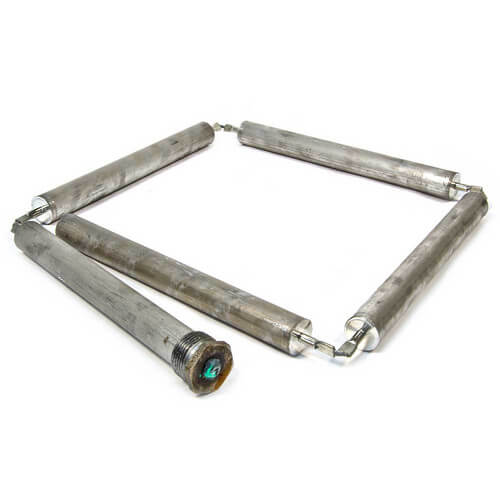
I fiddled and fussed and thought about it for a while. I tried to remove the top of the water heater to see if I could find the problem, but it's totally packed in there with expanding spray-foam insulation. I determined to just bite it and get a replacement water heater. I called Ian for advice, who referred me to Chauncey to talk about heat pump water heaters. Chauncey suggested that I check my anode... I had no idea what that meant; I assumed it was part of the electrical heating element. (I know of an anode as the negative electrode on a battery.) Turns out, there's a long rod hanging down inside your hot water heater, usually zinc aluminum, a passive element which chemically reacts with positive ions in the water to keep the water neutrally charged. This prevents the iron fittings that breach the pressure tank from rusting out right away. The anode "sacrifices" itself for the good of the tank--the zinc gets consumed in the reaction and will eventually get used up; then it's curtains for your water heater. Chauncey referred me to Jay at Consolidated plumbing, who looked up my water heater--nine years old! The warrantee expired after six years, and it took three more for the tank to fail. This does not seem like a reasonable lifespan for a $450 hot water heater!
If you know about your anode, if you bother to check it, and if you have the tools to get that fu#*@r out of there, you can stay on top of your zinc depletion problem. You can replace your anode every few years, extending the lifespan of your water heater indefinitely. (I say indefinitely, but I'm not sure--it'll probably rust out eventually anyway, but you can certainly keep it alive considerably longer.) Depending on the characteristics of your water, you may have to replace the anode every two years, or four, or maybe never. A replacement anode is about $40. The replacements come in sections, held together with links, so inserting/removing it doesn't require four feet of headroom; without that four feet of headroom, removing your stock anode will become and adventure--one of the many reasons hot water heaters are effectively disposable. (Another reason is that if you don't do the work yourself, you'll end up paying a plumber much of the money you save by replacing the anode. Dang.)
I tried to get the anode out of my old water heater, but I simply couldn't. It's hidden under the cold-water nipple--you have to remove the inlet line, then use channel-locks or vice-grips to grab the pipe (without destroying the threads!) and turn with a force equivalent to launching a rocket. I tried this on my empty water heater, and I couldn't get that rusted sucker to budge. I gave up, mostly because I knew what I'd see inside anyway--a four foot rod that looked like the craters of the moon, all eroded and eaten away. I also had my new water heater on the way, and had to prepare for installing it, so screw that old one.
Chauncey recommended I loosen my new anode while the water heater was in a convenient location so that when checkup time came it'd be easier. OMG, that thing was welded into place! I removed the cowling on my water heater to get access to the anode bolt, I had a long cheater on my socket wrench for leverage, I put all my weight into it, but the water heater wanted to rotate away, and the bolt wouldn't budge. I was at this for at least an hour, slowly realizing there was no way I could do this on my own, but having no one else to help. I talked with Chauncey again, and he suggested I fill the water heater--fifty gallons would help anchor it. Duh. I did that, braced it with a two-by-four so it wouldn't rotate, removed all the extensions from my socket wrench (which add too much play to the system) and used a four-foot cheater. It did finally move. I got that thing out of there and celebrated quietly. I taped the threads and put it back in, but not too tight. Next time I need to remove it, the water heater will be awkwardly positioned in the corner, but the anode will be relatively easy to turn.

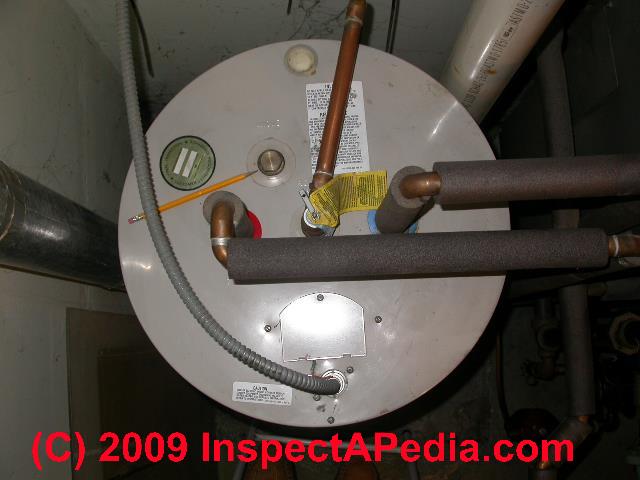
For those interested, there are usually four things coming out of the top of an electric hot water heater--the cold (inlet) nipple, the hot (outlet) nipple, the electrical connection, and the pressure relief valve. (The relief valve may be on the side somewhere, possibly even the inlet, but the anode and the hot outlet have to be on the top.) There is often another plastic cap up there, flush with the surface; if you remove this, you'll find the 1 1/16" anode head. That's if you're lucky--my anode, as I said, was hidden under the cold-water nipple. My new heater has a clearly visible anode down inside the cowling that houses the condenser pump--easy to spot, difficult to get to.

You might want to check into a heat pump heater next time you replace your water heater: $450 for electric; $1225 for heat pump, even more for on-demand, etc. The $1225 bill, for me, was mitigated by the fact that Seattle City Light offers a $500 (!!) rebate for a heat pump installation because it uses so much less electricity. By "so much less" I mean a projected difference of about 77%! My new heater is supposed to save me about $400 a year, which means it pays for itself easily in less than a year. That's crazy. The heat pump makes a lot of noise, but I don't care--it's in the basement. It has a nifty digital panel on front which allows you to switch between heat pump only, electric only, or hybrid mode. Hybrid mode uses the heat pump when maintaining temperature, or when demand is low, but cranks up the elements when demand requires. You can set the water temperature right there on the panel, and you can set it on "vacation mode" if you go away.
I didn't expect to become one of the cognoscenti this week, but it's been interesting. By the time I need to use this information again, I'll have probably forgotten it, but here's a record of it, with a date, so I can always look it up. Happy home owning!
* * *